
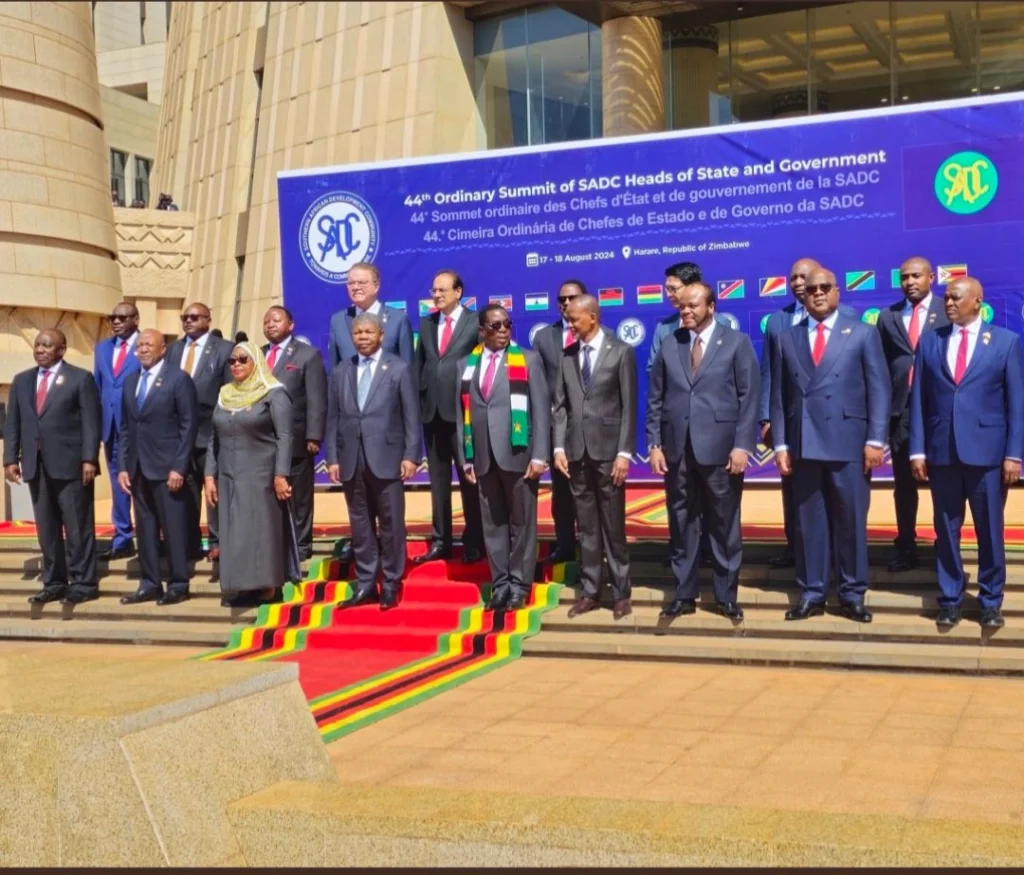
President Emmerson Mnangagwa may have claimed the chairmanship of the Southern African Development Community (SADC), but it has done nothing to clear the dark cloud hanging over his presidency. Despite his efforts, Mnangagwa has failed to convince SADC to withdraw the damning election observer report that declared Zimbabwe’s 2023 elections flawed and fraudulent. This leaves him not only facing a legitimacy crisis at home but also under quiet suspicion from the very regional body he now leads.
The SADC Election Observer Mission, led by Zambia’s former Vice President Nevers Mumba, was firm in its conclusion: the August 2023 elections in Zimbabwe did not meet the standards set by the country’s own constitution or SADC’s principles for democratic elections. The report clearly stated that the elections were not free, fair, or transparent. This report was not just quietly filed away—it was officially endorsed by SADC through its extraordinary summit in Angola and later reinforced at a ministerial meeting in Zambia.
Mnangagwa’s rise to SADC chairperson was expected by some to be his chance to erase this stain on his presidency. But the regional body has refused to budge. The report remains on the record, and SADC’s position has not changed. That’s a huge blow to Mnangagwa’s ongoing attempt to paint his leadership as legitimate and democratic.
Zambian President Hakainde Hichilema, who led the SADC troika on politics, defence, and security at the time of Zimbabwe’s election, played a crucial role in standing firm. Hichilema did not attend the Harare summit that followed the elections, a clear protest move. While he diplomatically described SADC elections during his term as “reasonably peaceful,” he refused to retract the Zimbabwe report. Hichilema’s principled stand—sending Mumba to lead the observer mission and backing the findings—marked a rare moment of regional accountability.
This has sparked diplomatic tension between Zimbabwe and Zambia. Lusaka has even asked SADC and the African Union to help manage the growing dispute. The fact that two neighbouring countries, both members of the same regional bloc, are now at odds over a stolen election shows just how serious the issue has become.
Mnangagwa’s usual strategy of spin, silence, and strong-arming has not worked this time. He has long relied on controlling domestic institutions and silencing opposition voices, but he has found that the same tactics don’t work regionally. SADC may be slow to act, and often reluctant to punish authoritarian behaviour, but the 2023 election report has proven surprisingly resilient.
This episode exposes not only Mnangagwa’s vulnerability but also the larger problem within SADC. The bloc has repeatedly struggled to take firm action against member states that violate democratic norms. Yet in this case, thanks to Hichilema and Mumba, SADC refused to look the other way. It’s a moment of rare clarity from a regional body that is often accused of protecting incumbents and turning a blind eye to election fraud.
Back home, Mnangagwa continues to jail opposition leaders like Job Sikhala and Jacob Ngarivhume, while pushing for a possible extension of his rule beyond 2028. But as long as that SADC report remains, so does the question: is he a legitimate leader or just another strongman clinging to power by manipulating votes and suppressing voices?
International observers, civil society groups, and even fellow African leaders now view Mnangagwa through a lens of skepticism. His position as SADC chairperson may give him prestige, but it has not removed the stain of that report. Instead, it has only drawn more attention to the contradiction between his title and his actions.
In the end, Mnangagwa’s chairmanship changes nothing. The SADC report still stands. The fraud is still recorded. And the crisis of legitimacy continues to haunt him. Until he addresses the fundamental issue—his flawed election and authoritarian governance—no amount of regional posturing will save him from the truth.
The region is watching. The world is watching. And most importantly, Zimbabweans are watching too.